Captain Ratatype
Whatever the case, this skill is genuinely important for everyone in the modern world: we type every day, and the faster and more confidently we do it, the more time and energy is left for the work itself. So today we'll talk about how to make learning touch typing genuinely interesting for kids — and turn routine practice into an exciting game.
Why ordinary typing exercises may «not click» with kids
Touch typing is a skill built on muscle memory. And muscle memory forms only through repetition: hundreds of identical finger movements until they start finding the right keys on their own. The problem is that to a child, such repetitions seem boring and uninteresting. There's no instant result or excitement, and progress is barely noticeable. Is it realistic to keep up motivation under such conditions?
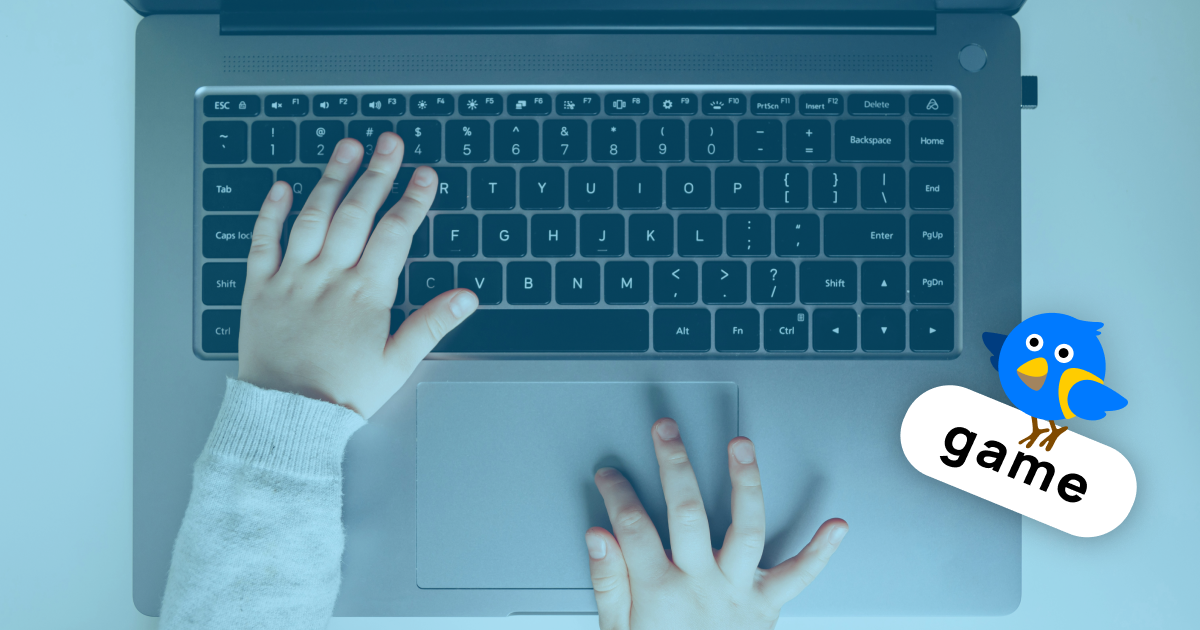
This is precisely where gamification comes to the rescue. Its main strength is that it breaks a big, boring task into small, understandable steps, while various formats and rewards keeps motivation up. The child is no longer «learning the layout of the keys» — they're rescuing a hero, overtaking a rival on the track, or beating their own record.
And meanwhile, the fingers are doing the work they need to.
What science says: games really do work
This isn't just a nice theory. Hungarian researchers Szabina Fodor and Márton Varga created an educational touch-typing game, Dungeon Typer, and tested it on students. The result — a noticeable improvement in typing skills and broad demand for this form of learning (Fodor & Varga, Springer, 2020).
Interestingly, one of the game's key principles is the motto «making a mistake is okay, trying again is good». The game even starts with a few «lives», because it's assumed that mistakes will happen, and that's part of the process, not a reason to get upset.
By the way, the idea isn't new. The legendary Mavis Beacon trainer proved decades ago that game elements increase typing speed and accuracy through structured exercises and interactive tasks (Gamification of learning, Wikipedia).
And a large-scale review of 90 scientific studies confirmed: gamification has a positive impact on student engagement in primary and secondary school (Frontiers in Education, 2024).
Which game mechanics specifically speed up learning
Not every game is equally useful. Here are the elements that really work for learning to type:
- Points, badges, and levels. They give the child visible progress. The student sees that they're moving forward and wants to keep going.
- Multiple attempts and «lives». They remove the fear of mistakes. The child isn't afraid to try, because they know: a failed attempt isn't a catastrophe (Fodor & Varga, 2020).
- Instant feedback. The game immediately shows speed and errors — something standard exercises often lack.
How to fit games into a lesson (without doing harm)
Games work best not instead of systematic learning, but alongside it. First, practice hand position and a specific row of keys with the kids in a trainer, then reinforce the result with a game. Games work well as a warm-up at the start of a lesson or as a reward at the end.
Just don't overdo it. Researchers honestly note: gamification doesn't work the same for everyone — the effect depends on context, design, and even the child's character. So games should complement training, not replace it.
And praise students for their attempts, not just for results.
If you want to try it in practice, Ratatype has everything for this: the keyboard games Ratashooter and Ratagons, a vibrant game interface, and for teachers — the ability to create classes and sync them with Google Classroom to track each student's progress.
So next time you see boredom according to your class, try a different approach. Let the kids play, and fast typing will come on its own. Simple and fun!
List of sources
- Fodor, S. and Varga, M. (2020) ‘Using gamification to improve students’ typing skills’, in Marfisi-Schottman, I., Bellotti, F., Hamon, L. and Klemke, R. (eds.) Games and Learning Alliance: GALA 2020. Cham: Springer, pp. 200–206. Available at: https://doi.org/10.1007/978-3-030-63464-3_19 (Accessed: 22 June 2026).
- Wikipedia (2026) Gamification of learning. Available at: https://en.wikipedia.org/wiki/Gamification_of_learning (Accessed: 22 June 2026).
- Ramírez Ruiz, J.J., Vargas Sanchez, A.D. and Boude Figueredo, O.R. (2024) ‘Impact of gamification on school engagement: a systematic review’, Frontiers in Education, 9. Available at: https://doi.org/10.3389/feduc.2024.1466926 (Accessed: 22 June 2026).